Mobile Developer
Software Engineer
Project Manager
Mobile Developer
Software Engineer
Project Manager
Tag: Technology

Neural Network Game Simulation: The Future of AI in Gaming
Introduction
The gaming landscape is evolving at a breakneck speed, with neural network game simulation at the forefront of this transformation. By employing sophisticated AI algorithms, game developers are crafting experiences that are not only more immersive but are also capable of adapting in real-time to player behaviors. As we delve into the recent advancements and trends in this burgeoning field, we will uncover how neural networks and diffusion models are revolutionizing the way we understand and interact with video games.
Background
The integration of AI game engines has significantly changed the dynamics of gaming over the past few decades. Traditional game engines followed predefined scripts and linear narratives. However, neural networks have introduced a paradigm shift, allowing for more responsive and adaptive game environments. Emerging techniques such as diffusion models for gaming have augmented this shift, enabling developers to simulate complex gameplay features without rigid programming lines.
A notable example is the transformation of classic games like DOOM into neural models. This adaptation utilizes convolutional neural networks (CNNs) to reimagine the gaming experience. The classic shooter has been enhanced to respond to player tactics and strategies, creating an intelligence that learns and evolves—often resulting in a richer gameplay experience. With research focused on integrating machine learning models, this evolution is just the beginning of what the future holds for gaming as we know it.
Emerging Trends
As we explore the forefront of real-time AI simulation, several key trends emerge that are reshaping the gaming landscape:
– Reinforcement Learning: This technique allows AI agents to learn from their interactions with players, fundamentally altering game design. You can think of it like a chess player who continuously improves their strategies by learning from past matches.
– Stable Diffusion Techniques: These methods enable AI to generate complex game environments on-the-fly, adapting visuals and mechanics in real time based on player actions. This means no two gameplay sessions are ever the same.
Together, these technologies enhance player interaction by creating deeply personalized experiences. Players are no longer mere passive participants; instead, they influence the narrative and gameplay dynamics, reflecting their choices and preferences in a seamless, intertwined manner. Ultimately, these trends signify a shift away from the static, scripted game experiences we have come to know.
Insights from Recent Innovations
Recent innovations in AI game simulation have paved the way for significant advancements in gameplay mechanics. An illustrative case study involves the transformation of the classic shooter game DOOM into a neural network model. According to recent studies, this adaptation has showcased how machine learning can elevate traditional gaming to new heights, enabling real-time, adaptive gameplay that responds not just to player actions, but also to game dynamics and changing contexts (HackerNoon, 2026).
Additionally, insights garnered from ongoing research highlight the successful combination of reinforcement learning and stable diffusion models. This newfound synergy is propelling game simulation into new territories, reshaping player experiences in increasingly complex and dynamic environments.
Moving forward, game developers equipped with these technologies are likely to push the boundaries of creativity, creating games that offer unprecedented levels of realism and immersion.
Future Forecast
The future of AI in gaming, particularly through neural network game simulations, looks promising and dynamic. Over the next decade, we can expect to see:
– Increased Personalization: With advancements in AI, games will become tailored not only to individual players’ styles but also to their emotional responses during gameplay. This customization could lead to gaming experiences that feel uniquely their own.
– Enhanced Storytelling: Neural networks holding the potential to dynamically generate narrative arcs could allow for personalized stories that adjust based on player decisions, diving deeper into emotional engagement than traditional linear narratives permit.
– Cross-platform Integration: As neural networks advance, we may see more seamless interoperability between devices and game engines, creating multiplayer experiences where players can interact with complex game worlds irrespective of their chosen platform.
In conclusion, neural network game simulation is not simply a futuristic aspiration; it’s rapidly becoming a reality that is reshaping the very fabric of the gaming industry. Developers, players, and enthusiasts must stay informed and engaged with these innovations to truly embrace the future of gaming.
Call to Action
As we stand on the brink of a new era in gaming, we encourage our readers to explore the emerging AI game engines and immerse themselves in the experiences they offer. Whether you are a developer, gamer, or an AI enthusiast, your participation is crucial in shaping the future of gaming.
Join the conversation about AI and your favorite gaming experiences on social media, and check out resources like the article on transforming classic shooter games into neural networks for more insights.
Read more about this transformation here. Together, let’s navigate the innovative landscape of AI in gaming!

Generative UI AI: Revolutionizing Interface Design in Agent-Driven Applications
Introduction
In the fast-paced digital landscape, Generative UI AI has emerged as a groundbreaking approach to interface design, fundamentally reshaping how applications interact with users. Unlike traditional UI design, which often relies on static layouts and predefined elements, generative UIs leverage the power of artificial intelligence to create dynamic interfaces that respond to user needs in real-time. This incorporation of AI-driven elements allows for a more intuitive and engaging user experience, transforming the way individuals and businesses operate online.
Background
To understand the significance of Generative UI AI, we must first delve into the concept of agentic UI. An agentic UI is an interface that empowers users by making interactions feel as though they are in control, thanks to the seamless integration of AI. This design philosophy prioritizes user experience, ensuring that applications are not only functional but also intuitive.
Central to this transformation is the AG-UI protocol, a framework that standardizes communication between AI backends and user interfaces. This protocol ensures that AI agents can convey their intent and state effectively, enabling a fluid exchange of information. Moreover, the rise of various payload formats, such as A2UI from Google, Open-JSON-UI from OpenAI, and MCP Apps developed by Anthropic and OpenAI, has played a pivotal role in advancing this technology. These formats facilitate the transmission of structured information, enabling UI components to be dynamically created or updated based on user interactions.
Trend
The trend towards generative UIs is evident across the technological landscape. As AI becomes increasingly integrated into our daily lives, the demand for innovative AI interface design solutions grows. Generative UIs stand out due to their ability to enhance user interactions, offering three main generative UI patterns:
1. Static UIs: These are fixed interfaces that are not designed to change based on user inputs.
2. Declarative UIs: Here, developers specify the desired state of the UI, allowing for some level of dynamic interaction.
3. Fully Generated UIs: These are entirely created by AI agents based on user behavior and context, showcasing the full potential of generative design.
As applications evolve, there is a noticeable shift from static designs to more interactive, agent-driven apps. This shift emphasizes the need for responsive interfaces that can adapt and grow with the user, making technology feel more personalized and accessible.
Insight
The implementation of generative UIs significantly enhances user engagement through dynamic features such as interactive forms, live charts, and progress indicators. These elements not only make the UI more visually appealing but also improve usability by providing immediate feedback and information.
Industry experts emphasize the efficacy of structured events within generative UIs. According to one expert quote, “User interactions are converted back into structured signals that the agent can reason over,” highlighting how each user action informs the AI, ultimately enhancing its reasoning capabilities. For example, when a user interacts with a chart, the AI can analyze the input and adjust future responses based on these insights, fueling a continuous feedback loop that benefits both the user and the system.
This interplay of inputs and AI reasoning opens up vast opportunities for creating agent-driven applications. By making user interaction the cornerstone of AI functionality, organizations can unlock actionable insights that lead to more personalized and effective solutions.
Forecast
Looking ahead, the future of Generative UI AI in application development appears incredibly promising. As technologies evolve, we can expect significant advancements in protocols like AG-UI that will simplify and enhance communications between AI backends and user interfaces. This will likely lead to broader adoption of generative UIs across various industries, from healthcare to finance.
Moreover, as applications increasingly rely on static and declarative UI approaches for security and testing, there will be greater emphasis on building systems that are both robust and user-friendly. The use of these methods will likely enhance security, ensuring that applications maintain integrity while offering interactive experiences.
As we move into this new era of application development, the potential for enhanced security measures and integrated testing approaches will play a vital role in how generative UIs are shaped and utilized, ensuring that while the user experience becomes increasingly dynamic, the underlying systems remain safe and reliable.
Call to Action
For those interested in diving deeper into the world of generative UIs, platforms like CopilotKit provide valuable resources to help you develop your own agentic UIs. This open-source framework offers SDKs and tools designed to simplify the creation of AI-driven interfaces.
To explore more about generative UIs and the AG-UI protocol, check out our full article which delves into the complexities and innovations behind these technologies. Start your journey towards creating more interactive and responsive applications today!
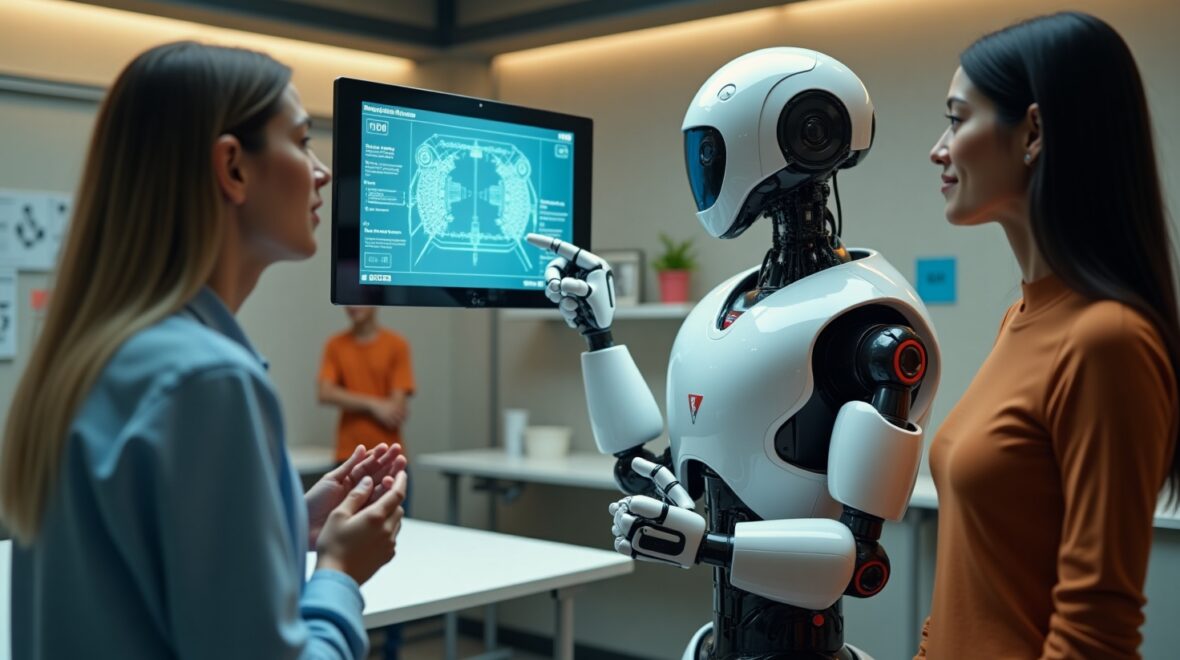
Vision Language Action AI: Transforming Real-World Robotics
Introduction
The concept of Vision Language Action AI (VLA AI) is rapidly reshaping the landscape of robotics and artificial intelligence (AI). At its core, VLA AI integrates visual recognition capabilities, linguistic comprehension, and actionable responses, allowing machines to interact with dynamic environments in an intuitive and effective manner. As robots become increasingly capable of performing complex tasks—from assembling products in manufacturing to assisting in medical procedures—the need for advanced AI systems that can understand and respond to visual cues and verbal commands intensifies. This intersection of capabilities represents a monumental leap in how robots can navigate the complexities of the real world.
Background
Vision Language Action AI is not an overnight phenomenon; it has evolved significantly through various technological breakthroughs. The integration of robotics AI models has paved the way for robots to perceive their surroundings more effectively.
Outstanding advancements in computer vision, natural language processing, and machine learning have contributed to this integration. For instance, most contemporary AI systems can now interpret visual inputs (like images and videos), process them linguistically (like understanding commands), and perform physical actions in a coherent sequence. Historically, systems that could perform one of these tasks—be it visual interpretation or executing commands—struggled to bridge the gap between perception and action.
The capacity for real-world manipulation has improved drastically, highlighting the importance of communication between AI models and physical environments. When a robot can not only \”see\” an object but also \”understand\” instructions conveyed in natural language, the possibilities expand exponentially. This foundational understanding sets the stage for further innovations.
Trend
The focus on dual arm robot control showcases a critical trend within the robotics sector, enhancing operational efficiency across various industries. The recent development of the Qwen2.5-VL model exemplifies how Vision Language Action AI is being actualized in practical applications. This model allows dual-arm robots to engage in manipulation tasks that require intricate coordination and real-time decision-making.
For instance, consider a robot designed for warehouse environments that uses the Qwen2.5-VL model to pick and sort products. With its advanced perception and action capabilities, the robot can \”see\” the location of items, \”understand\” an operator’s requests via voice commands, and effectively \”act\” by maneuvering its arms to retrieve the correct products. This advancement not only boosts operational productivity but also minimizes errors—a critical factor in time-sensitive environments.
Moreover, as companies increasingly adopt robots for routine tasks, the development of sophisticated robots equipped with VLA AI technology can handle multifaceted operations, from warehouse logistics to preparing and delivering medical supplies.
Insight
Vision Language Action AI’s practical applications are already manifesting across diverse industries, showcasing its transformative potential. In manufacturing, robots equipped with this technology streamline assembly lines, minimizing reliance on human intervention. They can accurately interpret visual inputs, execute language-based instructions, and interactively adapt to alterations in real-time manufacturing processes.
In healthcare, AI for real-world manipulation can improve surgical precision, as robots can follow detailed verbal directives during delicate procedures. Furthermore, collaborative robots, often referred to as \”cobots,\” utilize VLA AI to enhance service delivery in sectors like hospitality and customer service. A notable example highlighted by MarkTechPost is Ant Group’s Lingbot VLA, which functions as a versatile tool for enhancing user interfaces in service roles, demonstrating the potential of VLA technology in practical, low-risk environments.
This collaborative layer between humans and robots transforms how we approach tasks, suggesting a future where assistance from AI can significantly augment human capabilities.
Forecast
Looking ahead, the future of Vision Language Action AI is poised for significant advancements that will redefine its role in robotics. We can expect the development of even more sophisticated robotics AI models, enhancing the interaction quality between robots and their users.
As industries continue to evolve, the demand for intelligent automation solutions will rise. Companies will increasingly seek VLA-enabled robots that can not only interpret a broad array of commands but also adapt seamlessly to complex environments. Innovations in deep learning and neural networks will likely yield models that can understand and process more nuanced commands without extensive programming—think of robots that can learn new skills from observation and practice, much like humans do.
The implications for industries reliant on automation are vast, promising efficiency, improved safety, and operational flexibility across manufacturing, logistics, healthcare, and other sectors.
Call to Action
As we stand on the cusp of widespread adoption of Vision Language Action AI technologies, it becomes paramount for businesses and individuals to stay informed and proactively explore AI solutions tailored to their unique needs. The advancements in robotics offer exciting opportunities for enhancing productivity and simplifying complex tasks.
To learn more about these transformative AI technologies, consider looking into the developments shared by experts in the field. For further insight, you can read about Ant Group’s Lingbot VLA here.
The future of robotics, powered by Vision Language Action AI, is bright. Stay curious, stay informed, and prepare to leverage these innovative technologies in your pursuits!

The Impact of AI on Jobs: Transforming the Workforce
Introduction
In today’s rapidly evolving landscape, artificial intelligence (AI) significantly influences various sectors. The AI impact on jobs is profound, reshaping the very fabric of our workforce and altering the nature of employment. Understanding this impact is crucial as it not only affects individual career paths but also has broader societal and economic implications. This blog will delve into the historical context of AI and workforce dynamics, current trends in job disruption, insightful analyses from relevant literature, and potential future developments in the job market, all while providing a framework for preparing for these transitions.
Background
To grasp the AI impact on jobs, it’s essential to explore the historical context of AI’s evolution and its relationship with the workforce. Throughout history, automation has played a central role in transforming employment dynamics. The advent of machinery during the Industrial Revolution, for instance, created new job categories while phasing out others. Today, AI is set to continue this trend, albeit on a more complex scale.
As noted in various studies, including the insightful piece by rhortx titled \”Humanity’s Last Game of Musical Chairs Has Begun\”, the current acceleration in digital technology mirrors earlier shifts, such as the transition from agricultural to industrial economies. The ongoing dialogue around automation and employment suggests that while some jobs may become obsolete due to AI, new opportunities will arise, particularly in sectors focusing on technology integration and AI governance.
The intersection of human labor and AI capabilities creates a scenario where the workforce must adapt continuously. The nature of this adaptation is crucial for understanding the employment landscape influenced by AI.
Trend
Current trends signify that AI job disruption is at our doorstep, with statistics revealing a dramatic shift in employment across industries. A recent report indicates that nearly 50% of jobs are at risk of being automated in the next two decades. Industries such as manufacturing, retail, and customer service are particularly vulnerable to this disruption as AI technology becomes more prevalent.
Moreover, companies are already adapting by reshaping job descriptions:
– Data Analysts are now incorporating AI-driven insights into their regular assessments.
– Customer Service Representatives are assisted by AI chatbots, allowing them to focus on complex queries rather than routine inquiries.
These shifts indicate a transformation in job requirements, emphasizing skills like data literacy, emotional intelligence, and adaptability. This adaptation is not without challenges; workers must be equipped to transition into roles that complement AI rather than compete against it.
Insight
The article by rhortx provides valuable insights into how AI is steering societal and economic transformations. One notable perspective is the emergence of hybrid intelligence, which combines human intuition and creativity with AI’s analytical prowess. This duality in intelligence can facilitate innovative solutions that neither humans nor machines could achieve alone.
Moreover, aligning AI and human goals becomes imperative. As AI continues to proliferate, the risk of widening socio-economic divides multiplies. Professions centered around technology, like AI ethics and law, will burgeon while traditional roles may diminish. The discourse around employment trends AI should therefore extend beyond mere automation to encompass ethical considerations, ensuring that technological advancements lead to equitable growth across various sectors.
Notably, industries such as healthcare and education are also reaping the benefits of AI, where technology assists professionals rather than outright replacing them, thus indicating a potential pathway for other sectors adjusting to AI integration.
Forecast
Looking ahead, the employment landscape will undoubtedly evolve in response to AI advancements. While some positions will disappear, it is essential to recognize the potential for new job creation in various fields. Roles related to AI development, maintenance, and oversight will become increasingly vital. Employment trends AI are likely to usher in:
– Emerging job categories that integrate tech knowledge with traditional fields, fostering a new workforce identity.
– Curricular adjustments in educational institutions to emphasize not only technical skills but also soft skills that facilitate collaboration with AI technologies.
As organizations adopt a more hybrid workforce, the evolution of existing roles will entail more collaboration between humans and machines, reinforcing the notion that while AI can optimize efficiency, the human touch remains invaluable.
Call to Action (CTA)
We invite readers to engage with the topic of the AI impact on jobs actively. What are your thoughts on how AI will shape the future of work? How can you prepare for upcoming employment trends influenced by AI and automation? Join the conversation and consider the steps necessary to navigate these transitions effectively, ensuring both your personal and professional growth in an increasingly automated world. Let’s explore together how we can align our goals with those of emerging technologies, creating a future that benefits all.