Mobile Developer
Software Engineer
Project Manager
Mobile Developer
Software Engineer
Project Manager
Tag: Robotics

Tesla’s Bold AI Investment: Shaping the Future of Automotive Technology
Introduction
In a move that has sent shockwaves through the tech and automotive industries, Tesla has recently announced a staggering $2 billion investment in Elon Musk’s AI venture, xAI. This strategic investment not only reflects Tesla’s ambition to dominate the electric vehicle (EV) landscape but also indicates a significant pivot toward integrating advanced AI technologies into its products and services. As the competition heats up, particularly from juggernauts like BYD, Tesla’s focus on AI in electric vehicles and robotics is more than just a tactical adjustment; it’s a bold bid to redefine the future of automotive innovation.
Background
With its Master Plan Part IV, Tesla is not merely tinkering with electric vehicle technology but reimagining it through the lens of artificial intelligence. This includes the development of groundbreaking products like the Optimus humanoid robot, which poses the question: can a corporation traditionally known for cars also become a leader in robotics? Tesla’s integration of AI in the automotive sector isn’t just a gimmick; it’s a calculated effort to enhance vehicle autonomy and operational efficiency, pushing the boundaries of what’s possible in the realm of transportation.
The implications of this are profound. With competitors like BYD nipping at Tesla’s heels, the stakes have never been higher. As Tesla moves to incorporate the xAI Grok chatbot into its vehicles, it becomes clear that this investment is not just about robotics; it’s also a play for superior customer engagement and a more intuitive driving experience.
Current Trend
The automotive industry is undergoing a seismic shift, as automotive AI investments reshape competitive landscapes. Tesla has taken the lead by not only investing in cutting-edge technologies but also in committing to a long-term vision where AI informs every aspect of vehicle operation. In stark contrast, other automakers are still playing catch-up, scrambling to develop their own AI capabilities to stay relevant.
Consider this: just as the introduction of GPS revolutionized long-distance travel, AI does the same for how we think about moving. Competitors like BYD are increasingly using AI to enhance their electric vehicle offerings, but they still lack the sheer AI breadth and expertise that Tesla is aggressively cultivating through its partnership with xAI. This puts Tesla in a unique position—while others react, Tesla is innovating.
Key Insights
Tesla’s engagement with xAI raises a series of critical questions. What does this partnership truly mean for the future of the automotive industry? The potential outcomes from this $2 billion investment are fodder for both intrigue and skepticism. Here are some pivotal insights to consider:
– Enhanced Vehicle Autonomy: The goal of achieving Full Self-Driving capabilities hinges on Tesla’s advancements in AI. This investment signals the company’s intent to not just increase but revolutionize autonomy in vehicles, perhaps outpacing traditional drivers of the industry.
– Robotics Advancements: As Tesla pivots production to include humanoid robots like Optimus, the implications for manufacturing and mobility are extraordinary. Tesla could dominate a market that combines AI with robotics, potentially creating a feedback loop of innovation and efficiency that no other automaker can match.
– Strategic xAI Partnership: This alliance allows Tesla to leverage AI in electric vehicles beyond mere software updates, enhancing physical product capabilities. With Grok integrated into their offerings, Tesla can provide real-time insights, much like having a co-pilot with limitless knowledge.
Future Forecast
As we look ahead, the trajectory of Tesla within the AI landscape is anything but conventional; if anything, it’s teeming with audacity. Expect Tesla to double down on its focus on robotics and AI-centric projects, diversifying its portfolio beyond just electric vehicles. As Musk himself said, \”This year for Tesla is the first major steps as we increase vehicle autonomy and begin to produce Optimus robots at scale\” (Bloomberg).
There’s a rapid evolution taking place, with projections suggesting Tesla’s shift towards AI could reframe the electric vehicle market entirely. Over the next five years, we might see the emergence of fully autonomous fleets, accompanied by a range of robotic assistants capable of interacting with passengers in ways we have yet to imagine.
Call to Action
So, what does this mean for you? It’s essential to keep a scrutinizing eye on Tesla’s developments in AI and robotics and engage in the wider conversation about how technology is transforming the automotive landscape. Whether you’re an investor, a consumer, or simply an observer of technology trends, understanding Tesla’s journey could offer valuable insights into the future of personal and public transportation. Are you ready to embrace the revolution that is Tesla’s AI investment? Join the discussion as we hurtle toward a wildly innovative future.
—
As the world of automotive AI unfolds, remember to follow the latest updates and analyses that shape your perceptions of these revolutionary changes. For more detailed sources, check out the complete announcements from TechCrunch here and BBC here.
Driverless Taxis in the UK: Revolutionizing Urban Transportation
Introduction
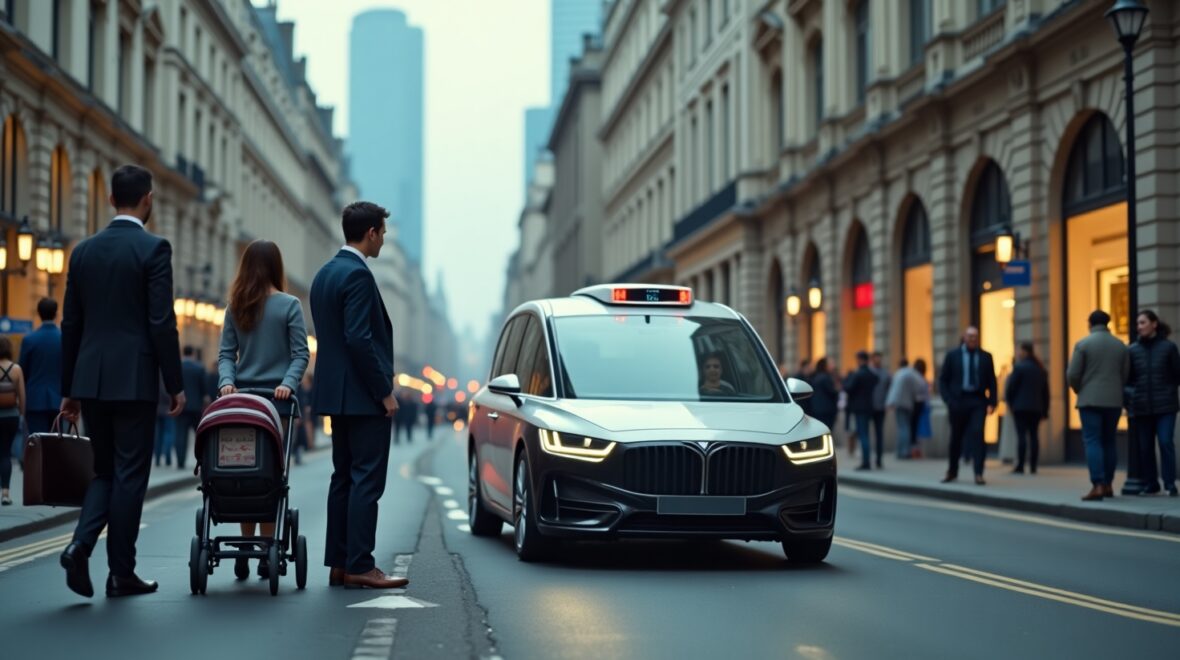
The advent of driverless taxis in the UK marks a significant shift in urban transportation dynamics. With the increasing sophistication of autonomous vehicles, cities like London are set to become testing grounds for robotaxi services. The race is on among tech giants such as Waymo and Uber to launch their own fleets, attracting mixed reactions from the public and regulators alike. These developments raise essential questions about safety, public acceptance, and the economic implications for urban centers.
Background
The emergence of driverless car technology traces back several decades, evolving from experimental concepts to prototypes and, finally, operational systems. The UK government has actively been updating its regulatory framework, supporting the transition from traditional taxis to autonomous vehicles.
In 2021, this commitment was highlighted by the government’s announcement to pilot a robotaxi service in 2026. By mid-2026, regulations will likely be in place to facilitate safe and efficient operations of driverless taxis. This timeline is crucial, not only for the companies involved but for the broader picture of urban mobility in the UK.
Current Trends in the Industry
The autonomous vehicle sector is witnessing transformative changes. Major players like Waymo are making headlines with their ambitious plans, including a partnership with Jaguar for an advanced fleet of London robotaxis. Spurred by the rise of AI, these vehicles utilize cutting-edge sensor technologies to navigate without human intervention, celebrating milestones such as over 173 million miles of fully autonomous driving primarily in the U.S. (source: BBC).
Additionally, competitive pricing models are emerging amidst efforts to optimize urban mobility. The anticipated entry of firms like Uber and Lyft, which are collaborating with companies like Baidu, adds an extra dimension to this budding market. As these robotaxis become more commonplace, they promise to provide a premium yet competitive pricing structure, potentially altering how urban populations commute.
Insights from Industry Leaders
Key industry figures are vocal about the potential of driverless taxis. Lilian Greenwood, the Local Transport Minister, emphasizes the importance of safety and cybersecurity measures in deploying these vehicles. Statistically, the autonomous vehicle industry is projected to add a staggering £42 billion to the UK economy by 2035 and generate nearly 40,000 jobs.
Quotes from technology leaders provide further context. A representative from Waymo pointed out that the transition to AI transportation must prioritize public safety and trust, echoing concerns around the impact of potential cyber threats. Such insights underline the complexities involved in rolling out robotaxi services.
Forecast for Driverless Taxis in the UK
As we look towards 2026, the forecast for driverless taxis in the UK is optimistic but fraught with challenges. Projected growth hinges on regulatory approvals, advancements in technology, and public acceptance. It is expected that by 2026, the integration of autonomous vehicles will begin transforming not just the transportation landscape, but the urban economy itself.
The rollout of London robotaxis could stimulate job creation in maintenance, support, and advanced computer science fields. However, these autonomous vehicles must overcome hurdles, including regulatory compliance and cybersecurity measures.
The anticipated integration not only boosts convenience but also encourages innovation in urban transport solutions, improving access for the community. As these developments unfold, public discussions must be inclusive, ensuring citizen perspectives are accounted for.
Call to Action (CTA)
As driverless taxis begin to take shape in the UK, avid followers of technology and transportation are encouraged to stay informed about emerging trends. Consider subscribing to updates on societal shifts with the advent of robotaxi services or engaging in discussions on AI transportation. The shift towards autonomous mobility is not just a technological change but a profound transformation in everyday life. With the future of urban transportation at our doorstep, everyone has a role to play in shaping this journey.
Stay alert; the ride toward a driverless future may be closer than you think!
Future Optical Flow Prediction: Revolutionizing AI with FOFPred
Introduction
As the field of artificial intelligence evolves, one innovative advancement that stands out is Future Optical Flow Prediction (FOFPred). This groundbreaking technology aims to redefine robotic applications and video generation by enhancing motion prediction capabilities. By predicting the optical flow of future frames based on current video inputs alongside natural language instructions, FOFPred offers unprecedented accuracy and performance for various AI applications, including robot control AI and video generation AI.
In this article, we will delve deeper into FOFPred’s technical aspects, its strategic advantages over existing models, and its transformative potential for the future of AI technology.
Background
The development of FOFPred is rooted in the integration of vision language models with advanced machine learning frameworks. It uses a unified architecture that includes a frozen vision language model, a frozen variational autoencoder (VAE), and a trainable diffusion transformer. This innovative setup allows FOFPred to predict up to four future optical flow frames from a combination of images and textual information.
To understand FOFPred’s capabilities, consider it akin to a skilled translator who converts real-time visual inputs into actionable language-driven predictions. Just as a translator adeptly interprets nuances in languages, FOFPred captures complex motion patterns in a video and translates them into precise robot control movements or video outputs. Trained on large-scale web videos with relative optical flow targets, FOFPred does not merely memorize but learns to generalize across various scenarios, leading to improvements not only in robotic manipulation but also in video synthesis and generation.
The Trend of Optical Flow Prediction in AI
The surge in interest surrounding motion prediction AI has been fueled by advancements in model architecture and data training techniques. FOFPred stands at the forefront of this trend, creating significant improvements in how machines interpret and predict motion within video data. The advent of such complex prediction models allows engineers and researchers to enhance the capabilities of robots in dynamic environments where real-time decision-making is crucial.
The concentration on optical flow prediction is a response to increasing demands in industries that rely on robotics for tasks that require high precision, such as automated manufacturing and autonomous vehicles. As researchers continue to optimize these models, FOFPred’s architecture offers potential applications across diverse domains, including healthcare, surveillance, and animation.
Advancements like FOFPred are reshaping how we perceive and utilize AI for motion understanding, setting new standards for performance efficiency and accuracy. As AI technology evolves, systems that leverage FOFPred will likely become essential components of innovative applications designed to interact seamlessly with human environments.
Insights into FOFPred’s Performance
FOFPred’s performance has been rigorously evaluated against benchmark datasets, most notably CALVIN ABCD and RoboTwin 2.0, where it has demonstrated remarkable superiority. For instance, it achieved a 78.7% success rate on Task 5 of the CALVIN ABCD benchmark, outperforming competitors like VPP and DreamVLA. This level of proficiency signifies not just incremental improvements but a significant leap in AI capabilities.
– CALVIN ABCD benchmark: FOFPred 4.48 vs. VPP 4.33 and DreamVLA 4.44
– RoboTwin 2.0 average success rate: FOFPred 68.6% compared to VPP’s 61.8%
In video generation tasks, FOFPred has surpassed models like CogVideoX, yielding impressive performance metrics such as:
– SSIM: 68.4
– PSNR: 22.26
– FVD: 75.39
These statistics underscore FOFPred’s ability to not only predict future optical flow frames but also maintain high fidelity and realism in generated videos, establishing itself as a frontrunner in the burgeoning field of video generation AI.
Future Forecast for Optical Flow Prediction Technologies
Looking ahead, the future of optical flow prediction technologies is promising, particularly as FOFPred becomes increasingly integrated into mainstream AI applications. With ongoing advancements, FOFPred is likely to facilitate more sophisticated robot manipulation, enabling robots to perform complex tasks with intuitive anticipatory movements.
Moreover, its integration into text-to-video generation pipelines can revolutionize creative industries, allowing for automated content creation that adapts based on user input. The potential for FOFPred to enhance engagement and interactions in virtual environments could see it utilized in sectors such as entertainment and gaming.
As competition in AI intensifies, FOFPred is set to elevate expectations, pushing developers to innovate further in motion prediction and its allied fields. The implications for industries reliant on autonomous systems are vast, paving the way for enhanced capabilities and new applications previously thought unattainable.
Call to Action
In summary, FOFPred is not just a technological advancement but a transformative tool poised to redefine the landscape of AI applications in motion prediction and video generation. For those interested in the convergence of machine learning and robotics, exploring FOFPred provides an exciting opportunity to stay at the forefront of this rapidly evolving field.
To learn more about FOFPred and its pioneering applications, check out the detailed insights shared by Salesforce AI here. Join the discussion on how FOFPred can shape the future of AI and transform industries by sharing your thoughts below or engaging with professionals in this field!