Mobile Developer
Software Engineer
Project Manager
Mobile Developer
Software Engineer
Project Manager
Tag: Generative AI

AI Collaboration Models: The Future of Intelligent Interaction
Introduction
In today’s rapidly evolving digital landscape, AI collaboration models are emerging as a pivotal force driving intelligent interaction across various sectors. These models represent a significant shift from traditional, standalone AI applications to more dynamic systems where multiple AI agents collaborate seamlessly with humans. This change is particularly crucial in enterprise settings, where complex tasks often require not just solitary inputs but coordinated efforts for optimal outcomes.
Background
At the core of these AI collaboration models are foundation models, which are large-scale machine learning systems trained on diverse data sources to excel in various tasks. Traditionally, these models focused primarily on tasks like information retrieval or code generation. However, the advent of collaborative AI agents marks a transition towards models designed to manage intricate workflows with a keen emphasis on social intelligence.
The rise of collaborative agents can be significantly attributed to the efforts of industry professionals, particularly alumni from companies like Anthropic. For instance, the startup Humans&, founded by former Anthropic employees, is developing innovative foundation models that prioritize communication and collaboration over mere data processing. Their goal is to create a \”central nervous system\” for effective human-AI cooperation, enhancing workplace productivity to create value for both enterprises and consumers.
Trend
The current trajectory in AI development shows a marked shift from single-user assistance to sophisticated AI coordination. This transformation is especially evident in enterprise AI applications, where the complexity of tasks often overwhelms individual efforts. Here, social intelligence becomes crucial, allowing AI to understand human dynamics and effectively facilitate interactions within teams.
Recent advancements in training methods, including long-horizon and multi-agent reinforcement learning, greatly bolster the potential for effective AI coordination. For example, consider how a well-coordinated sports team functions: athletes must recognize not only their roles but also how their actions influence teammates. Similarly, collaborative AI agents equipped with these advanced training techniques can learn to interact strategically with users, optimizing workflows and improving decision-making processes.
Insight
Industry leaders recognize the pressing need for collaborative AI agents to manage the increasing complexities in enterprise workflows. Notable figures like Reid Hoffman, co-founder of LinkedIn, emphasize that \”AI lives at the workflow level, and the people closest to the work know where the friction actually is.\” This highlights the importance of building AI collaboration models that are not just reactive but actively enhance and streamline workflow processes.
Humans& exemplifies this ideology, aiming to transform existing collaboration platforms such as Slack and Google Docs by introducing AI that understands human interactions deeply. As CEO Eric Zelikman puts it, \”We are building a product and a model that is centered on communication and collaboration.\” This ambitious approach signals the potential for AI tools that genuinely facilitate teamwork rather than merely automating tasks.
Forecast
Looking ahead, the future trajectory of AI collaboration models promises to revolutionize both enterprise and consumer applications. Startups like Humans& could redefine team dynamics and workplace interactions by creating platforms that genuinely understand and anticipate users’ needs. In this rapidly expanding arena, collaborative AI tools are poised for remarkable growth, as evidenced by Humans& raising $480 million and other companies like Granola, which secured $43 million for their AI-powered note-taking services.
As competition heats up among established AI corporations and innovative startups, the demand for more sophisticated, social-intelligent collaborative tools is likely to rise exponentially. This movement toward effective AI coordination could reshape organizational structures, emphasizing fluidity and adaptability in teamwork.
Call to Action
As we venture further into the world of AI collaboration models, it’s essential for professionals and enthusiasts alike to stay informed about the latest advancements. Have you begun to incorporate AI into your team’s workflow? We invite you to share your experiences with AI collaboration tools in the comments below.
For a deeper dive into the emerging trend of human-AI collaboration and innovative developments by pioneers in the field like Humans&, check out their latest insights here.
Be part of the conversation and witness how collaborative AI will shape the future of work.
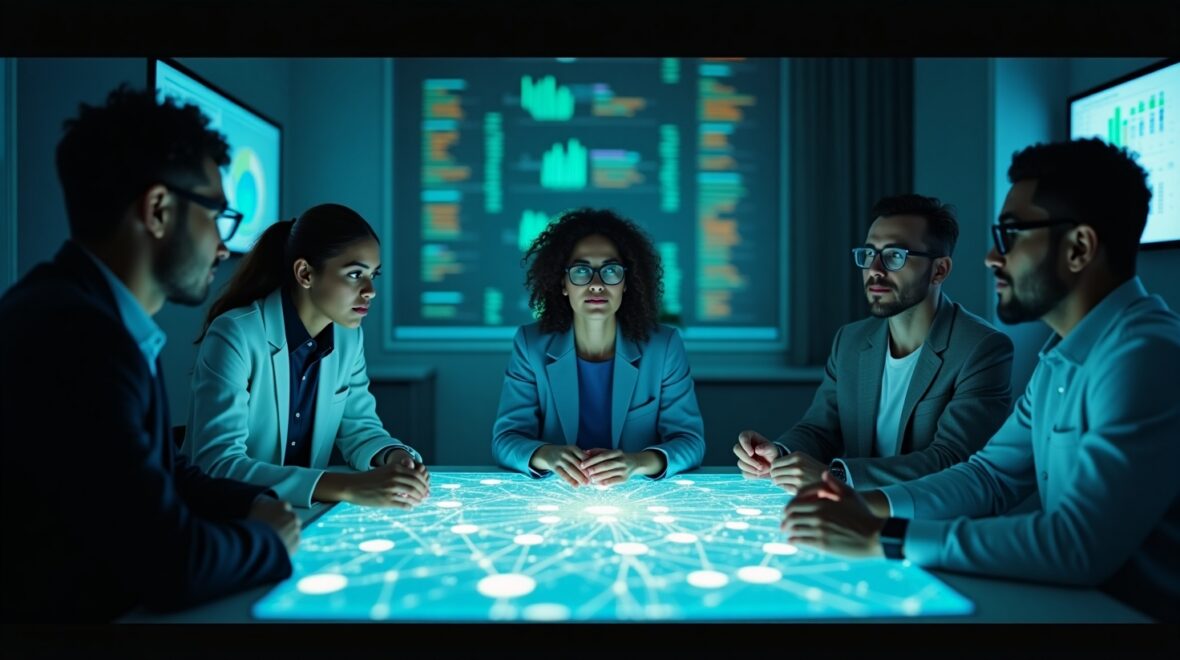
AI in Cybersecurity: A Comprehensive Overview
Introduction
In today’s digital age, the importance of AI in cybersecurity cannot be overstated. As we witness an exponential increase in cyber threats, organizations are turning to artificial intelligence (AI) to fortify their defenses. Generative AI security solutions are emerging as groundbreaking approaches designed to enhance threat detection and prevention strategies. With its ability to analyze vast amounts of data quickly, AI has the potential to identify vulnerabilities and predict potential attacks long before they occur.
However, the reliance on AI technologies also raises critical questions about efficacy and operational challenges. Though AI can revolutionize cybersecurity, businesses must navigate the intricacies involved in its integration while embracing the potential transformations it can bring.
Background
Traditionally, cybersecurity was rigorously defined by manual processes and static defenses. Organizations employed firewalls, antivirus software, and basic intrusion detection systems to combat cyber threats. While these methods laid the groundwork for digital security, they often fell short against sophisticated attacks that evolved at unprecedented rates.
Enter AI-driven approaches, which significantly alter the landscape by using machine learning algorithms to analyze patterns and behaviors in real-time. With capabilities to process vast troves of data, AI threat detection systems can spot anomalies and alert security personnel almost instantaneously. However, the shift towards AI isn’t without its challenges:
– AI operational challenges: Integrating AI into cybersecurity frameworks often leads to concerns regarding data quality, bias in algorithms, and the necessity for continual learning and updating systems.
– Complexity of cyber threats: The rising sophistication of cyber threats—from phishing attacks to multi-vector assaults—demands intelligent solutions that traditional methods struggle to provide.
As organizations increasingly seek intelligent security solutions, the market is ripe for innovations that not only address current vulnerabilities but also anticipate future attacks.
Current Trends in AI and Cybersecurity
The evolution of AI in cybersecurity brings forth a variety of new methodologies and tools aimed at enhancing protection capabilities. Recent advancements in AI threat detection technologies have paved the way for:
– Proactive monitoring: AI systems can analyze user behavior and system interactions to identify potential security breaches before they escalate.
– Enhanced cybersecurity automation: Organizations are adopting automated systems that not only detect threats but also respond to them with pre-defined protocols, reducing response times and minimizing human error.
– Human-in-the-loop AI: This approach marries human intuition with AI capabilities by involving human analysts in the decision-making process, ensuring that ethical considerations are taken into account while improving the AI’s systems through continuous training.
The combination of these elements creates an adaptive and highly effective security framework that continuously learns and evolves, further protecting organizations from a myriad of potential threats.
Insights from Industry Experts
Drawing from Zac Amos’s article on AI hype versus reality in cybersecurity, it’s vital to distinguish myths from facts regarding AI’s capabilities in the field. Amos emphasizes several misconceptions, such as the belief that AI can function autonomously without human oversight. While AI excels in processing information and generating actionable insights, the reality is that human expertise remains indispensable in combating cyber threats.
Statistics presented in the article highlight efficiency gains from AI implementations, revealing that incident response times can be cut by up to 40% when AI is deployed effectively. Moreover, real-world applications underscore how AI technologies have successfully thwarted cyber attacks at companies across various sectors.
As organizations begin to harness AI more comprehensively, understanding its realistic contributions versus exaggerated expectations is crucial for ensuring effective cybersecurity strategies.
Future Forecast: AI’s Role in Cybersecurity
Looking ahead, the future of AI in cybersecurity is promising yet presents challenges. As technology progresses, we anticipate several key developments:
– Further automation: The emergence of fully automated cybersecurity solutions may streamline processes, but organizations must remain vigilant in addressing emerging AI threats and biases in algorithms.
– Evolution of AI threat detection methods: AI will continue to enhance data analytics techniques, potentially leveraging advanced techniques like neural networks and deep learning to identify complex attack patterns across networks.
– Generative AI security: The next phase of generative AI security could prompt a reimagining of how organizations craft their defenses, with AI systems simulating cyberattacks to test and fortify their infrastructures in real time.
The evolution of cybersecurity practices, framed by advanced AI technologies, reveals that while potential exists, organizations must commit to thoughtful, informed integrations of these systems.
Call to Action
As businesses increasingly face a multitude of cyber threats, exploring AI integration into cybersecurity strategies is essential. Stakeholders should stay informed about emerging trends and tools, ensuring their cybersecurity measures remain robust and effective.
To continue expanding your knowledge on this vital subject, consider reading Zac Amos’s insightful article on AI hype versus reality in cybersecurity here. The fusion of human insight with AI-driven capabilities can lead to a more secure digital future—one where organizational vulnerabilities are continuously mitigated through intelligent solutions.
Related Articles
– \”AI Hype vs Reality in Cybersecurity Explained\” by Zac Amos: An exploration of the distinctions between excitement surrounding AI and its actual capabilities in the cybersecurity field.
By harnessing the potential of AI technologies while remaining critical of their integration, we can prepare for the evolving landscape of cybersecurity in an increasingly digital world.